Guide & comparison · PV measurement technology · Solar park O&M

Solar PV testers compared

This comparison evaluates selected PV testers up to 1500 V for use in solar parks. It looks beyond technical specifications and also assesses measurement practice, software, data workflow, reporting, operating cost drivers and operational suitability for O&M teams.

  • Comparison based on the sunparq assessment method
  • Focus on utility-scale PV, solar park O&M and 1500 V applications
  • Assessment beyond the datasheet: workflow, software, reporting and operating costs

Context

Why a PV tester comparison needs more than technical specifications

PV testers are often evaluated first by measurement ranges, functions and purchase price. For solar park O&M teams, that is not enough.

What matters is how well a device fits into day-to-day operations: How long does preparation take per string? How quickly can a measurement be completed? How well does the software support data management and reporting? And how easy is it to onboard new technicians?

This comparison therefore evaluates the devices not only by datasheet, but with the sunparq assessment method focused on utility-scale O&M.

Assessment method

The sunparq assessment method

The comparison table evaluates PV testers not only by technical specifications, but by their practical effect on the O&M process. Purchase and operating costs are intentionally classified qualitatively as High, Medium or Low. In addition, sunparq considers core functions, software workflow and measurement functions that are relevant for measurement practice, documentation and repeatable solar park workflows.

Purchase

How high is the entry point for the device, required accessories, software and field-ready configuration? The assessment classifies whether the purchase block is comparatively low, medium or high.

Operating costs

How much operational effort is created by measurement, preparation, assignment, data handling, documentation and post-processing per string? This classification is also intentionally qualitative.

Core functions

Which functions support the real field process: direct validation on the device, auto procedures, performance diagnostics, fault diagnostics, PV module database and integrated visual inspection?

Software & measurement functions

How well do data transfer, cloud, documentation and core measurement functions fit the O&M workflow - from UOC, ISC and RISO to irradiance, temperature, diode tests and operating currents?

Comparison table

Solar PV testers in direct comparison

The comparison table uses the sunparq assessment method and intentionally classifies purchase and operating costs qualitatively. Instead of exact figures, it uses the categories High, Medium and Low so that the focus remains on use case, workflow and O&M process.

High = high cost or effort block Medium = medium cost or effort block Low = low cost or effort block
Criterion PVM-1530 Pro MI 3116 PV Analyser XA PV 125 PVCHECKs ProPlus
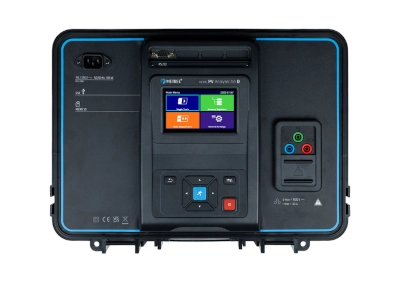
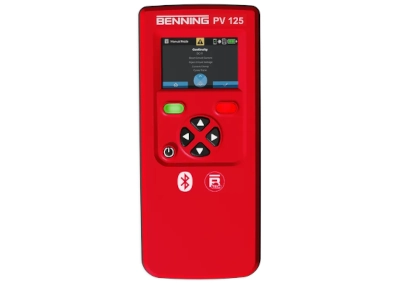
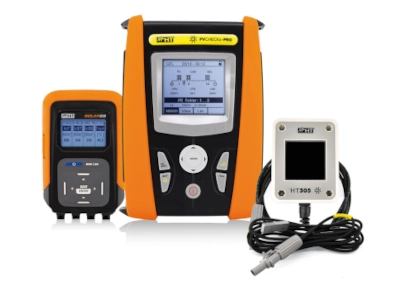
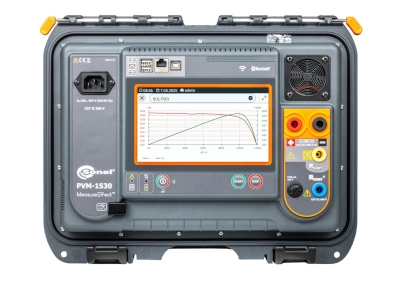
Product image PVM-1530 Pro PV tester 1500 V MI 3116 PV Analyser XA PV tester up to 1500 V PV 125 PV tester up to 1500 V PVCHECKs ProPlus PV tester up to 1500 V
Manufacturer Sonel Metrel Benning HT Instruments
Purchase
Classification Device / set / accessories / field-ready configuration High

Moderately high costs

High

High costs

Low

low costs (separate accessories considered)

Medium

medium costs (separate accessories considered)

Operating costs
Measurement / string Assessment of measurement time and effort for UOC, ISC, RISO Medium

Fast measurement possible; prepared project structure reduces time between measurements

Low

Very fast measurement possible; setup and operating logic are somewhat more complex

Low

Very fast measurement possible; but no validation on the device

High

Time-consuming measurement; setup and operating logic are complex

Preparation / string Effort for setup, assignment, structure and post-processing for UOC, ISC, RISO Low

One-time effort for project structure and procedures; afterwards very fast workflow for measurement and documentation

Medium

One-time effort for project structure and procedures; more effort for transfer, documentation and data management

High

Time-intensive preparation and post-processing in BTEC

High

Time-intensive preparation and post-processing on device and software

Core functions
On-site measurement validation Option for direct validation on the measuring device ✓

Direct validation in the measurement result

✓

Direct validation in the measurement result

X

Manual validation in BTEC

✓

Direct validation in the measurement result

Auto procedures Fixed / flexible measurement procedures and automated workflows ✓

Flexible measurement procedures + automation

✓

Flexible measurement procedures + automation

✓

Fixed measurement procedures

✓

Fixed measurement procedures

Performance diagnostics Environmental-data-supported curve measurement ✓

Extended performance parameters: inclusion of module degradation and installation age

✓

Only fill factor (FF) as performance parameter

X X
Fault diagnostics Measurement functions that enable fault analysis ✓

RISO (DC up to 1500 V with GFL, AC up to 1000 V), RLow (200 mA), bypass/blocking diode test

✓

RISO (DC up to 1500 V), RLow (200 mA)

✓

RISO (DC up to 1500 V), RLow (200 mA)

✓

RISO (DC up to 1500 V), GFL, RLow (200 mA)

PV module data Internal device database/storage ✓

PV module database from the cloud or locally editable

✓

PV module database from MESM or locally editable

X

No database/storage

✓

Storage for 64 PV modules

Visual inspection Integrated in the measuring device ✓

Flexibly configurable visual inspection (cloud-side and device-side)

✓

User-defined visual inspection

X

No visual inspection

X

No visual inspection

Software
Name MeasureEffect MESM BTEC TOPVIEW
Data transfer Wi-Fi / USB

Wi-Fi sync from measuring device to cloud; USB for local data

USB / RS232

Local via USB / RS232 or data via mobile cloud app and cloud storage to MESM

Bluetooth

Via Bluetooth to BTEC

USB / Wi-Fi

Via USB / Wi-Fi to TOPVIEW

Cloud ✓

Full cloud with projects, procedures, data management and documentation

✓

Cloud app and cloud storage as data transfer to MESM

✓

Extensive cloud with projects, documentation and data management

X
Documentation creation ✓ ✓ ✓ ✓
Measurement functions
Open-circuit voltage DC 1500 V

max. 1650 V

1500 V

max. 1700 V

1500 V 1500 V
Max. short-circuit current DC 40 A

Power-dependent: ISC(1000 V) = 40 A, ISC(1500 V) = 30 A

40 A

Power-dependent: 48 kW

25 A 40 A
Insulation measurement (DC side) up to 1500 V

250, 500, 1000, 1500 V; GFL function

up to 1500 V

250, 500, 1000, 1500 V

up to 1500 V

250, 500, 1000, 1500 V

up to 1500 V

250, 500, 1000, 1500 V; GFL function

Insulation measurement (AC side) up to 1000 V

250, 500, 1000 V

X X X
Protective conductor and equipotential bonding with 200 mA ✓ ✓ ✓ ✓
Irradiance and temperature ✓

with IRM-1 (all-in-one)

✓

with A 1785 PV + A 1833 PV + A 1846 PV

✓

with SUN 3 + temp. sensor (050424)

✓

with SOLAR03 + HT305 + PT305

Diode tests ✓

Measurement of bypass and blocking diodes

X X X
Operating currents ✓

with CMP-1015 PV

X ✓

with CM 3-PV

X

Note: This table is a qualitative sunparq assessment. The ratings for purchase and operating costs are intentionally simplified into the categories low, medium and high. They do not replace checking the latest manufacturer information, a project-specific economic calculation or a technical assessment of the concrete use case. Despite careful maintenance, no claim is made to completeness; sunparq aims to review and update the table regularly.

Interpretation

How the comparison table should be read

The table is not a simple feature list and not a price ranking. It shows how the devices should be understood in a practical O&M context: purchase, measurement and preparation effort, direct validation, software workflow, documentation and measurement scope must always be considered together.

Low purchase cost does not automatically mean low total effort

A device with a low entry price can still create more operational effort if preparation, post-processing, data structure, validation or documentation need to be organized more manually.

Direct validation and procedures reduce field risks

For O&M teams it matters whether measurement results can be assessed directly on the device and whether fixed or flexible measurement procedures make the workflow repeatable. This affects measurement quality, speed and rework.

Software determines how usable measurement data becomes

Cloud, data transfer, documentation, project structure and reporting determine how well measurement data can later be used in the O&M process. Especially with several technicians, plants or partners, this point often becomes more important than individual device functions.

Cost model

The economics of PV measurement technology

The economic comparison of PV testers does not end with the purchase price. What matters is how a device affects ongoing O&M operations: measurement time, preparation, data handling, reporting, training effort and error prevention all influence the actual total cost.

The following illustration intentionally shows only one part of this economy: purchase costs plus the cost share of measurement time directly at the string. Other factors such as preparation time per string, employee training effort, data export, report creation, accessories, calibration or repeat measurements are not yet included in this example.

Example: total costs with measurement time at the string

Simplified model: purchase costs plus cost share of measurement time per measured string.

Example costs = purchase + strings × measurement-time costs/string
PVM-1530 Pro
MI 3116 PV
PVCHECKs ProPlus
PV 125

Note: This illustration is not a complete TCO model. It only considers purchase costs and the cost share of measurement time directly at the string. It does not include preparation time per string, training effort, data handling, reporting, accessories, calibration, support, error costs or repeat measurements.

Not sure which device fits?

The best tester comparison is the one that considers your process

We review not only datasheets, but also team structure, use case, software, reporting and the effort per measurement campaign.

Related pages

Explore individual devices, software workflows and training in detail

The comparison table shows the main differences at a glance. For a concrete selection, device functions, data transfer, software, documentation and training needs should then be reviewed in detail.

PV testers in detail

Detailed device pages for PVM-1530 Pro, MI 3116 PV Analyser XA, PV 125 and PVCHECKs ProPlus - focused on measurement functions, accessories, use case and O&M workflow.

Software & data transfer

Classification of software workflows such as MeasureEffect, MESM, BTEC and TOPVIEW: data transfer, cloud, project structure, documentation and reporting in the practical measurement process.

Training & measurement process

Training helps teams connect measuring device, accessories, software, data structure and reporting into a repeatable workflow in the solar park.

FAQ

Frequently asked questions about the PV tester comparison

What does the PV tester comparison evaluate?

The comparison evaluates PV testers not only by technical specifications, but by their practical usefulness in the O&M process. It considers, among other factors, purchase, operating costs, measurement time, preparation, direct validation, software workflow, data transfer, documentation and relevant measurement functions.

Why does the table use High, Medium and Low instead of exact costs?

Prices, accessory packages, software models and internal process costs can vary significantly depending on country, distributor, project size and team structure. That is why sunparq intentionally classifies purchase and operating costs qualitatively as High, Medium and Low. The focus is on the relative effort in the O&M workflow, not on daily changing individual prices.

Is a device with a low purchase cost automatically more economical?

No. A low entry price can be offset by higher effort for preparation, data structure, validation, documentation or post-processing. For O&M teams, the decisive point is how well device, accessories, software and reporting work together.

Why are measurement time and preparation evaluated separately?

The measurement directly at the string is only one part of the total effort. Additional effort is created by project structure, assignment, device setup, environmental data, data transfer, documentation and post-processing. This separation helps distinguish fast measurements from truly efficient end-to-end processes.

What role does software play in the comparison?

Software determines whether measurement data later remains traceable, reviewable and report-ready. The table therefore considers data transfer, cloud functionality, documentation and the practical workflow with MeasureEffect, MESM, BTEC or TOPVIEW.

Is the table complete and permanently up to date?

No. Despite careful maintenance, no claim is made to completeness. Manufacturer information, software functions, accessory packages and prices can change. sunparq aims to review and update the comparison table regularly.

Does the comparison replace a project-specific device selection?

No. The table is intended as orientation. For a concrete selection, measurement tasks, plant structure, team size, existing software, reporting requirements and the planned O&M process should be assessed separately.

Can sunparq support the selection and introduction of a measuring device?

Yes. In the Measurement Assessment, use case, measurement tasks, team structure, accessories, software, data workflow and reporting requirements are reviewed together. Afterwards, sunparq can support rollout, training and Operational Readiness.

Next step

In 15 minutes, we clarify whether and how we can help

We first review your target setup, team structure, PV testers, reporting and support needs - then we decide together whether Assessment, Rollout or Operational Readiness is the right fit.

Maximum 2,000 characters.

* Required field

We use your information exclusively to process your request.